
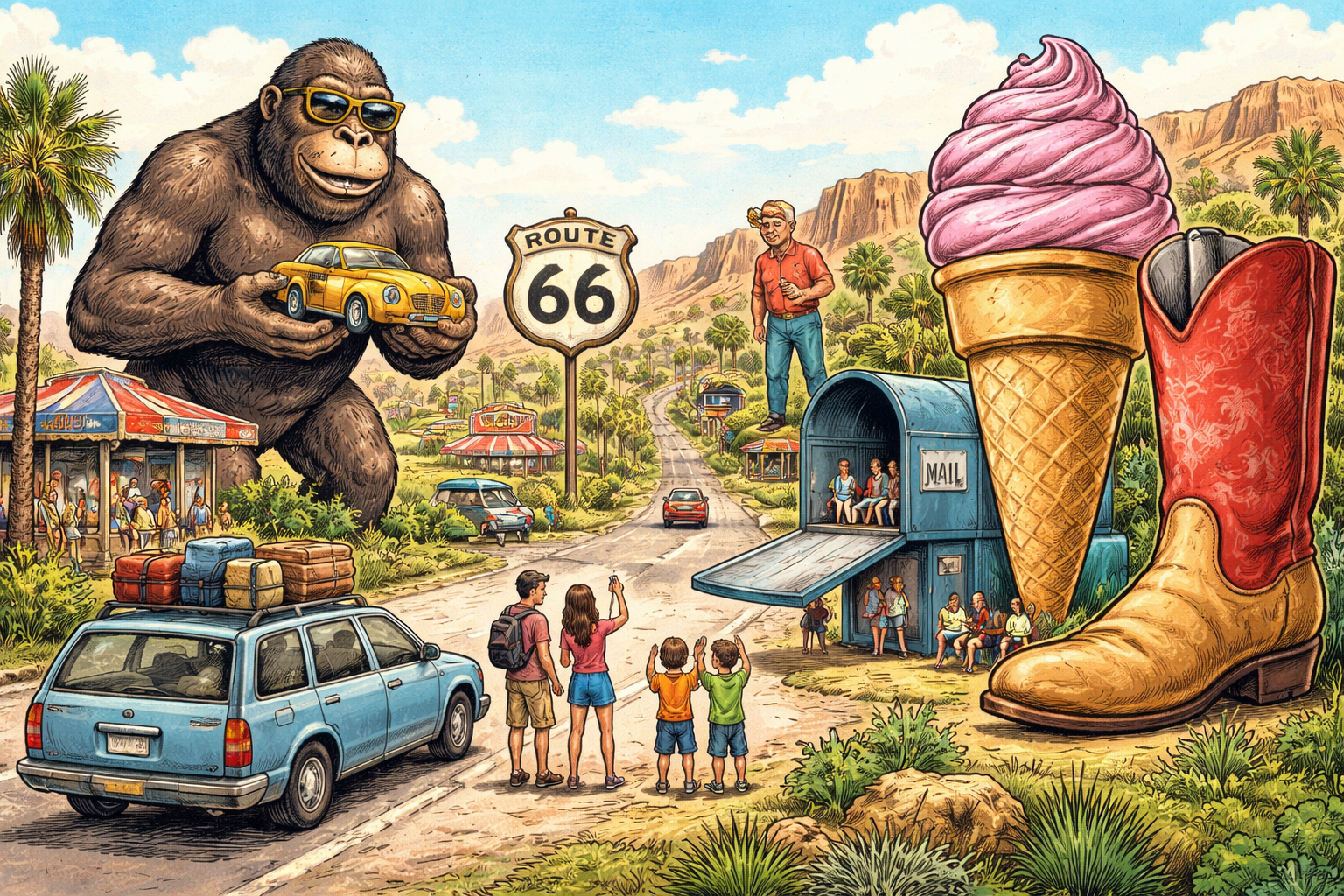
If you’ve ever pulled over to photograph a 30-foot gorilla or a mailbox big enough to walk inside, you’ve experienced the legacy of Route 66, whether you realized it or not.
Route 66 didn’t invent the idea of big things.
But it perfected the strategy.
It turned oversized roadside attractions into an economic engine.
And nearly 100 years later, that strategy still works.
Let’s unpack how one highway reshaped American travel culture and why giant landmarks remain one of the most powerful tools for family road trips today.
The Core Problem Route 66 Towns Faced
When Route 66 was established in 1926, it connected Chicago to Santa Monica, running through dozens of small towns along the way.
That connectivity was opportunity.
But it was also competition.
Every town wanted drivers to stop for gas. For food. For lodging.
And here’s the uncomfortable truth:
Drivers don’t stop for ordinary.
They stop for remarkable.
Small towns needed a way to interrupt attention.
So they built big.
Oversized as Strategy, Not Gimmick
It’s easy to label giant roadside attractions as kitschy or random.
They weren’t.
They were marketing innovation.
Before digital ads. Before billboards dominated highways. Before algorithmic targeting, towns relied on visibility.
If you built something tall enough, bright enough, or strange enough, it could be seen from miles away.
A massive coffee pot wasn’t decoration.
It was advertising.
A towering statue wasn’t novelty.
It was survival.
And along Route 66, this strategy flourished.
Why “World’s Largest” Became a Competitive Phrase
One town builds a big rocking chair.
The next town builds a bigger one.
Claiming “world’s largest” wasn’t just bragging rights. It created psychological urgency.
Travelers don’t want to miss the biggest.
Especially families.
Especially kids.
That competitive escalation birthed a culture of oversized roadside attractions that still defines American travel.
The Psychology Behind Giant Landmarks
Let’s shift into the cognitive side.
Oversized objects trigger what psychologists call schema disruption they violate expectation.
Mailboxes are small.
Animals are proportional.
Fruit fits in your hand.
When those expectations are shattered, attention spikes.
Attention strengthens memory.
That’s why kids remember giant roadside attractions long after they forget how many miles were driven.
And Route 66 towns understood this, even if they didn’t use psychological terminology.
They knew bigger meant unforgettable.
Route 66 and the Birth of Roadside Americana
As post-war tourism expanded in the 1940s and 1950s, Route 66 became the epicenter of family road travel.
Motels leaned into themes.
Diners leaned into neon.
Attractions leaned into exaggeration.
The highway became a curated visual experience.
And that visual identity became what we now call “roadside Americana.”
Without Route 66, America’s giant roadside attraction culture likely wouldn’t exist in the same way.
The Interstate Threat And Why Giants Survived
When the Interstate Highway System expanded in the 1950s and 1960s, many Route 66 towns were bypassed.
Traffic dropped.
Businesses closed.
Yet something interesting happened.
The oversized attractions didn’t disappear entirely.
Some deteriorated.
But others became heritage landmarks.
What started as marketing evolved into identity.
Today, many of these giant roadside attractions are restored, preserved, and celebrated, especially during Route 66’s 100th anniversary year.
Why Giant Roadside Attractions Still Work for Families
Let’s bring this into the present.
Parents today are competing with screens for attention.
Phones. Tablets. Streaming content.
Yet oversized roadside landmarks still interrupt that digital flow.
They demand physical presence.
Kids look up from devices when they see something massive on the horizon.
That’s powerful.
It creates:
- Shared reaction
- Shared humor
- Shared memory
And shared memory builds family narrative.
How to Use This Intentionally on Your Next Road Trip
Understanding the history gives you leverage.
Here’s how to apply it:
Seek Out “World’s Largest” Stops
Search along historic Route 66 stretches or adjacent towns.
Look for:
- Giant animals
- Massive everyday objects
- Vintage programmatic architecture
Turn the Stop Into Conversation
Ask:
- Why did this town build this?
- How did it attract travelers before smartphones?
- What would we build today?
You’re layering economics, psychology, and creativity in a five-minute parking lot stop.
Extend the Experience Creatively
Encourage kids to:
- Sketch the landmark
- Rank it against others
- Design their own giant roadside attraction
That reinforcement deepens retention.
The Centennial Effect
Route 66 turning 100 years old is not just symbolic.
Communities are restoring signage. Revitalizing landmarks. Hosting centennial events.
That renewed energy highlights something important:
Oversized roadside attractions weren’t accidents.
They were smart.
They were strategic.
And they continue to drive tourism nearly a century later.
The Bigger Lesson
Route 66 teaches us that attention is currency.
In 1926, attention came from visibility.
In 2026, attention comes from interruption.
And giant roadside attractions remain one of the most effective interruption tools in American travel.
Because they’re tangible.
They’re surprising.
They’re impossible to scroll past.
Still Creating Memories
Route 66 didn’t just connect cities.
It connected imagination to infrastructure.
It sparked a competition that gave America its giant gorillas, oversized fruit, towering thermometers, and whimsical roadside icons.
And today, as families rediscover the Mother Road during its 100th anniversary, those giants still stand.
Still drawing drivers off the highway.
Still creating laughter.
Still building memories.
Leave a Reply