
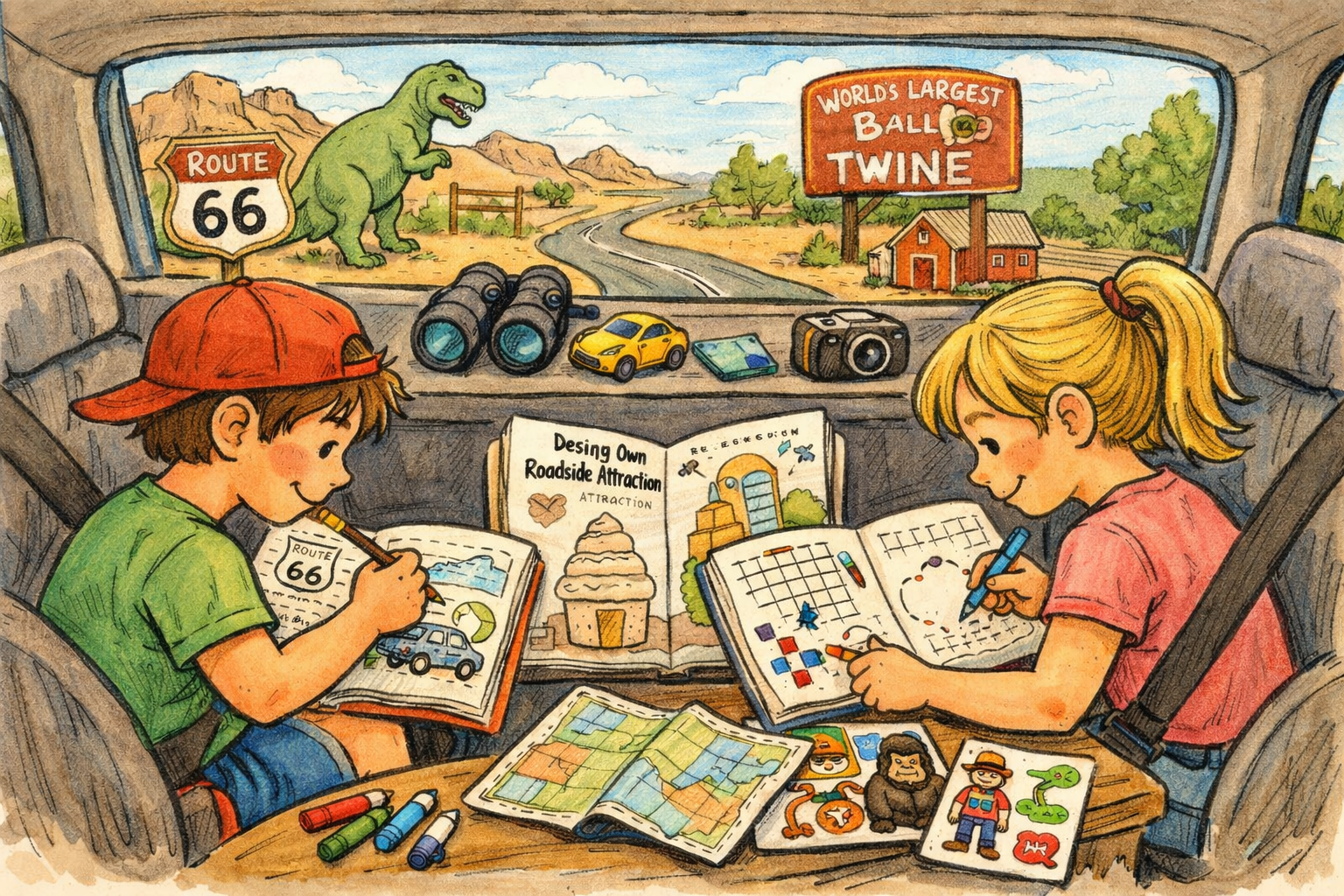
There are hundreds of activity books marketed for kids.
Airplane-themed. Dinosaur-themed. Puzzle-heavy. Sticker-packed. Character-branded.
When you’re preparing for a long road trip or family vacation, one question matters more than the cover design:
Will this actually hold my child’s attention?
Because a travel activity book isn’t just entertainment. It’s a travel tool. It’s a peacekeeping instrument. It’s sometimes the difference between “Are we there yet?” and “Can I do another page?”
So what actually makes a great travel activity book for kids?
Let’s break it down, practically and strategically.
Relevance to the Trip
The strongest travel activity books connect to the environment.
This is often overlooked.
If you’re driving across historic corridors like Route 66, visiting small towns, or exploring quirky roadside landmarks, a generic cartoon activity book won’t fully engage.
But a travel-themed book, especially one featuring:
- Roadside attractions
- “World’s largest” landmarks
- Americana icons
- State-specific imagery
…creates context.
And context increases attention span.
Kids are more engaged when the content mirrors what they’re seeing outside the window.
That connection matters.
Balance Between Structure and Creativity
Some activity books lean heavily into puzzles.
Others lean entirely into open-ended drawing.
The best travel activity books find balance.
They offer:
Clear prompts
Simple but engaging illustrations
Enough freedom for creative interpretation
Activities that don’t require constant adult supervision
Why does this matter?
Because travel environments are unpredictable. Parents are navigating. Managing snacks. Watching traffic. Handling logistics.
A strong travel activity book allows children to work independently — but still feel guided.
That autonomy reduces friction.
Clean, Bold Design
This may seem minor. It’s not.
Travel means movement. Cars shift. Airplanes bump. Lap desks wobble.
Overly detailed pages with tiny spaces frustrate kids quickly.
Look for:
- Thick outlines
- Simple focal points
- Minimal clutter
- Single-sided pages (to avoid bleed-through)
Bold, simple line art performs significantly better in travel settings.
It reduces cognitive overload.
And reduced overload equals longer engagement.
Page Count That Matches the Trip
A 20-page activity book won’t survive a multi-day road trip.
For extended travel, look for:
- 40–60+ pages
- Varied content types
- Repeatable formats
Kids work through pages faster than expected; especially during the first few hours of excitement.
A robust page count ensures longevity.
Encourages Conversation, Not Just Quiet
Here’s something I’ve observed repeatedly:
The best travel activity books spark dialogue.
A giant roadside gorilla illustration invites:
“Have you ever seen something like this?”
A “design your own landmark” prompt invites:
“What would we build in our town?”
Conversation transforms passive activity into shared experience.
And shared experience builds family narrative.
Developmentally Aligned for Ages 4–12
Travel often includes siblings.
That means activity books should scale across age groups.
For younger children:
- Larger images
- Fewer intricate details
- Clear prompts
For older children:
- Slightly more complex pages
- Open-ended design challenges
- Real-world tie-ins (history, geography, culture)
Books that hit this balance allow families to use one shared resource.
That’s efficient and cost-effective.
Screen-Free by Design
Screens are easy.
But screens also:
- Increase overstimulation
- Shorten patience thresholds
- Disconnect kids from surroundings
Travel activity books, especially themed ones tied to real-world landmarks or oversized roadside attractions, help children stay present.
Presence is the goal.
When kids color or engage with content connected to their environment, they process the trip more deeply.
And deeper processing equals stronger memory.
Built for Reflection
A great travel activity book doesn’t just distract.
It extends the experience.
Look for content that encourages:
- Ranking favorite stops
- Sketching visited landmarks
- Designing their own giant attraction
- Writing one sentence about the day
Even brief reflection dramatically increases retention.
And it creates emotional ownership of the trip.
Why Travel Activity Books Matter More Than Ever
Family travel today competes with:
- Digital entertainment
- Shortened attention spans
- Fast-paced itineraries
The intentional use of a high-quality travel activity book introduces:
- Rhythm
- Structure
- Creativity
- Pause
Pause is underrated.
When you pause, to color, sketch, reflect, you slow the trip down just enough to absorb it.
And that’s where memory lives.
A Simple Buying Checklist
Before purchasing a travel activity book, ask:
- Does this connect to our destination or route?
- Is the design bold and easy to color in a moving vehicle?
- Will it hold attention for multiple days?
- Does it encourage creativity and conversation?
- Is it age-appropriate for my child?
If the answer to most of these is yes, you’ve likely found a strong fit.
It’s a Memory Making Tool
A great travel activity book isn’t just about keeping kids busy.
It’s about keeping them engaged.
Engaged with the environment.
Engaged with their imagination.
Engaged with the family narrative unfolding around them.
When chosen intentionally, a travel activity book becomes more than paper and ink.
It becomes a tool for memory-making.
Leave a Reply